The short answer
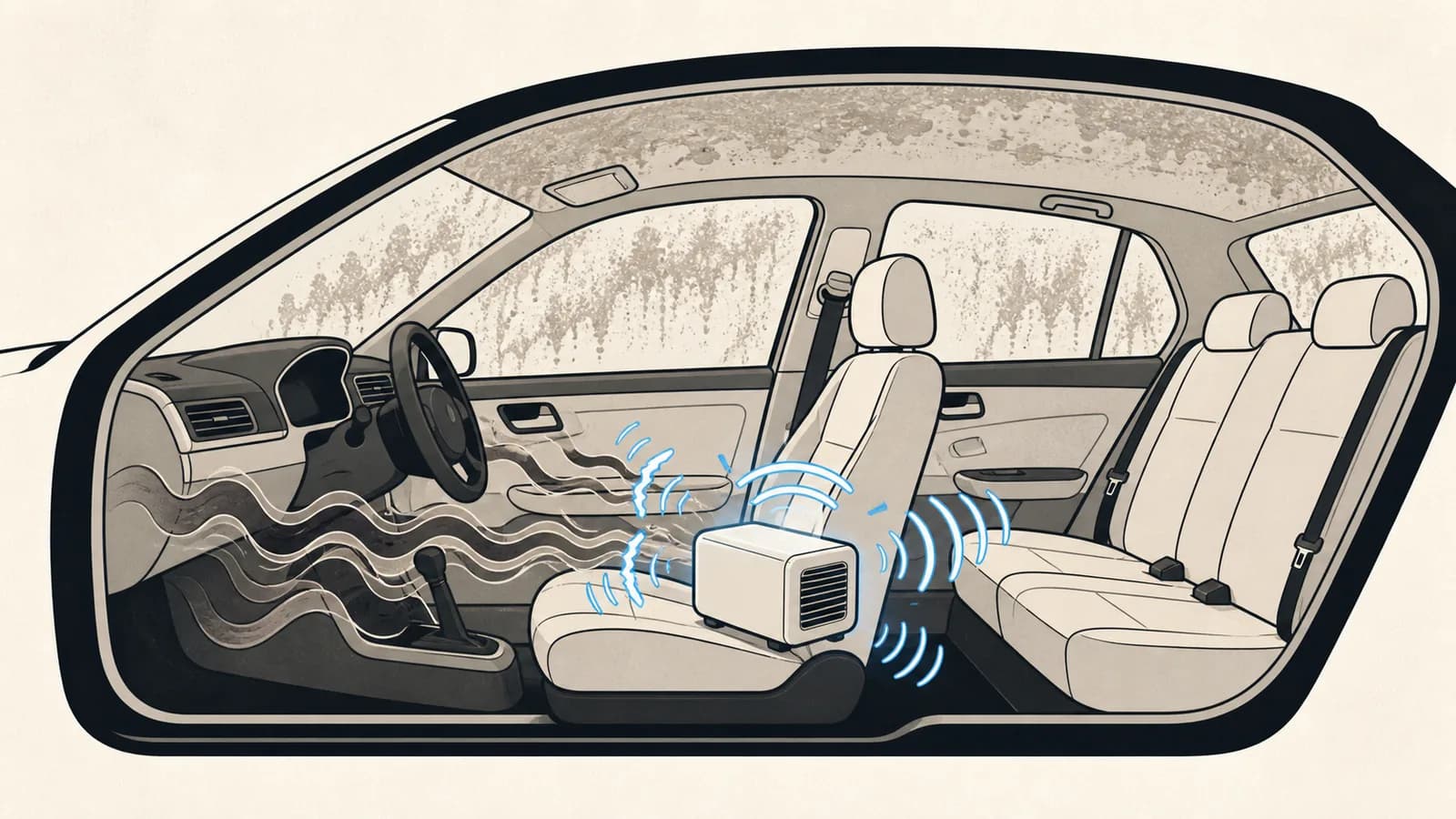
Smoke odor is a physical film of tar and residue on every surface in the cabin, plus contamination in the ventilation system. Removing it takes four steps in order: strip the film, extract the soft surfaces, treat the HVAC, then ozone to finish. Skipping any one of them leaves the smell.
Full odor elimination covering all four steps is $199. Ozone alone at $50 will not remove a smoker's car odor, because the residue is still there for it to come back from.
Where the smell actually lives
- The headliner, which is fabric over foam and holds more residue than any other surface.
- The inside of the glass, where the film is visible as haze at an angle.
- Every hard surface: dash, console, door cards, pillars, and the inside of the sun visors.
- The seats and carpet, into the foam.
- The cabin air filter and the ducting behind the dash.
The four-step process
| Step | What it handles | Why it cannot be skipped |
|---|---|---|
| Surface film removal | Tar on hard surfaces and glass | This is the majority of the smell |
| Extraction and steam | Seats, carpet, and headliner residue | Soft surfaces are the reservoir |
| HVAC and cabin filter | The ventilation system | Otherwise every startup re-scents the cabin |
| Ozone treatment | What remains, at a molecular level | Finishes the job rather than starting it |
What each step removes
The realistic expectation
A one-owner smoker's car of many years may not come back to neutral in one pass, and we will tell you that before we start rather than after. Full odor elimination is $199 and covers extraction, enzyme treatment, HVAC, and ozone.
Vape is different, and not always easier
Vape residue is largely propylene glycol and vegetable glycerin, which leaves a sticky film rather than a tar film. It smells less immediately but it builds a sticky layer on glass and hard surfaces that attracts dust, and it works into the same soft surfaces.
The removal process is the same, though the surface film usually comes off more easily. The headliner and the ventilation system still need the same attention.
Why this matters for resale
Smoke odor is one of the few interior conditions that measurably moves what a buyer will pay, because it is the one thing a buyer knows they cannot fix themselves. It is also the first thing noticed on a test drive on a hot day.
If you are selling a car that has been smoked in, this is the highest-return service you can buy before listing it.
What to expect at each stage
Smoke removal is progressive rather than instant, and knowing the shape of it prevents the common assumption after step one that the job has failed.
- 1After surface cleaning: the smell is noticeably reduced and the glass is dramatically clearer.
- 2After extraction and headliner work: the residual smell drops again, and it stops rebuilding on hot days.
- 3After the ventilation system is treated: the burst of smell at startup disappears.
- 4After ozone: what remains is neutralized, and the car should smell of nothing rather than of a product.
- 5A week later: any smell that returns indicates residue left somewhere, most often the headliner or the ducting.
This is an educational guide written to help DFW drivers budget and decide with confidence. It is not a binding quote. Your price is confirmed up front before any work begins, with no deposit.