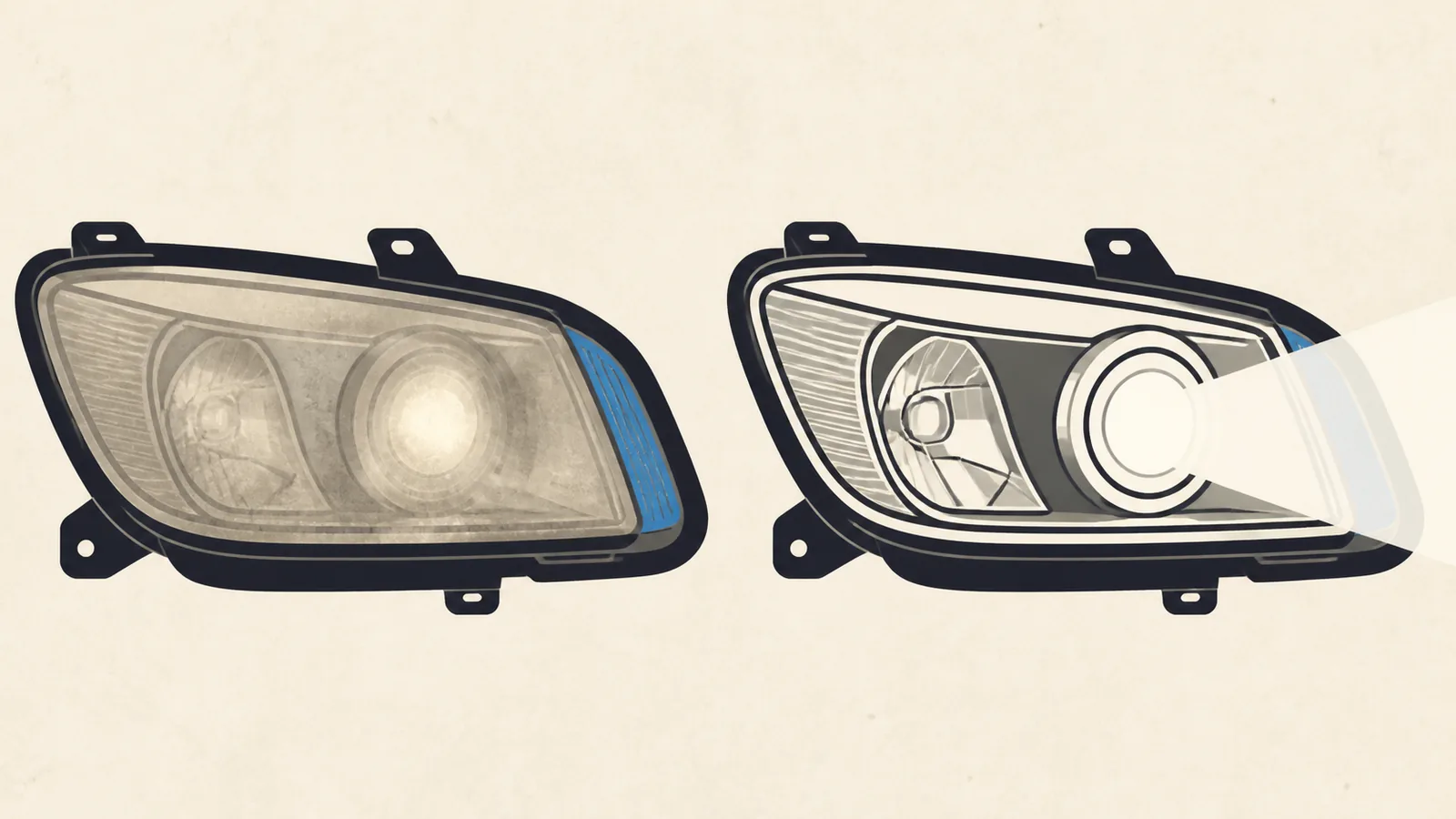
The short answer
For the vast majority of foggy, yellowed headlights, restoration is the answer, and it costs a fraction of new lens assemblies. The haze is oxidation on the outside of the plastic lens, so sanding it off, polishing the lens clear, and sealing it with UV protection restores clarity and night vision (a pair runs from $149, with a UV seal included). Replacement only makes sense when the lens is cracked, the housing is fogged on the inside, or moisture has gotten in.
Here is how to tell which situation you have, and why the seal is the step that actually matters.
| Situation | Best call | Rough cost |
|---|---|---|
| Yellowed, hazy surface oxidation | Restore | From $149 the pair, UV seal included |
| Cracked or broken lens | Replace | New assembly |
| Internal fogging or condensation | Replace | New assembly |
| Moisture collecting inside the housing | Replace | New assembly |
Restore or replace, by what is actually wrong
Why headlights fog in the first place
Modern headlights are polycarbonate plastic, not glass, and the factory UV coating on them breaks down over time. The Texas sun accelerates it. Once that coating fails, UV oxidizes the surface of the lens, which is what you see as the yellow, cloudy haze. It is a surface problem, which is exactly why it can be sanded and polished away.
It is also a safety problem, not just a cosmetic one. A hazed lens scatters and blocks light, cutting your output at night when you need it most. Restoring the clarity measurably improves how far and how well you see after dark.
The restoration process, and the step that matters
Restoration is mechanical: mask off the surrounding paint, wet-sand the lens through progressively finer grits to remove the oxidized layer, then machine-polish it back to optical clarity. The before-and-after is one of the most dramatic in detailing, and it makes the whole car look years younger.
But here is the step that separates a lasting job from one that fogs up again in months: the UV seal. Sanding alone exposes raw, unprotected plastic that re-oxidizes fast. A proper UV-protective coating locks in the clarity, which is why we always seal the lens and back it with a two-year seal. If a restoration skips the seal, it is not really finished.
Restored, sealed, and backed for two years
A restored pair runs from $149 with the UV seal included, never as an upsell after the sanding. It is one of the most dramatic before-and-afters in detailing and a real night-vision upgrade.
When replacement is the right call
Restoration works on surface oxidation. It cannot fix a lens that is physically cracked, a housing with internal fogging or condensation, or a headlight where moisture has breached the seal and is collecting inside. In those cases the assembly itself has failed and needs replacing.
For everything else, which is most foggy headlights, restoration is the smart money: a dramatic improvement, better and safer night vision, and a fraction of the cost of new assemblies. It pairs naturally with a full detail or pre-sale prep, since clear headlights make the whole front of the car look new.
This is an educational guide written to help DFW drivers budget and decide with confidence. It is not a binding quote. Your price is confirmed up front before any work begins, with no deposit.