The short answer
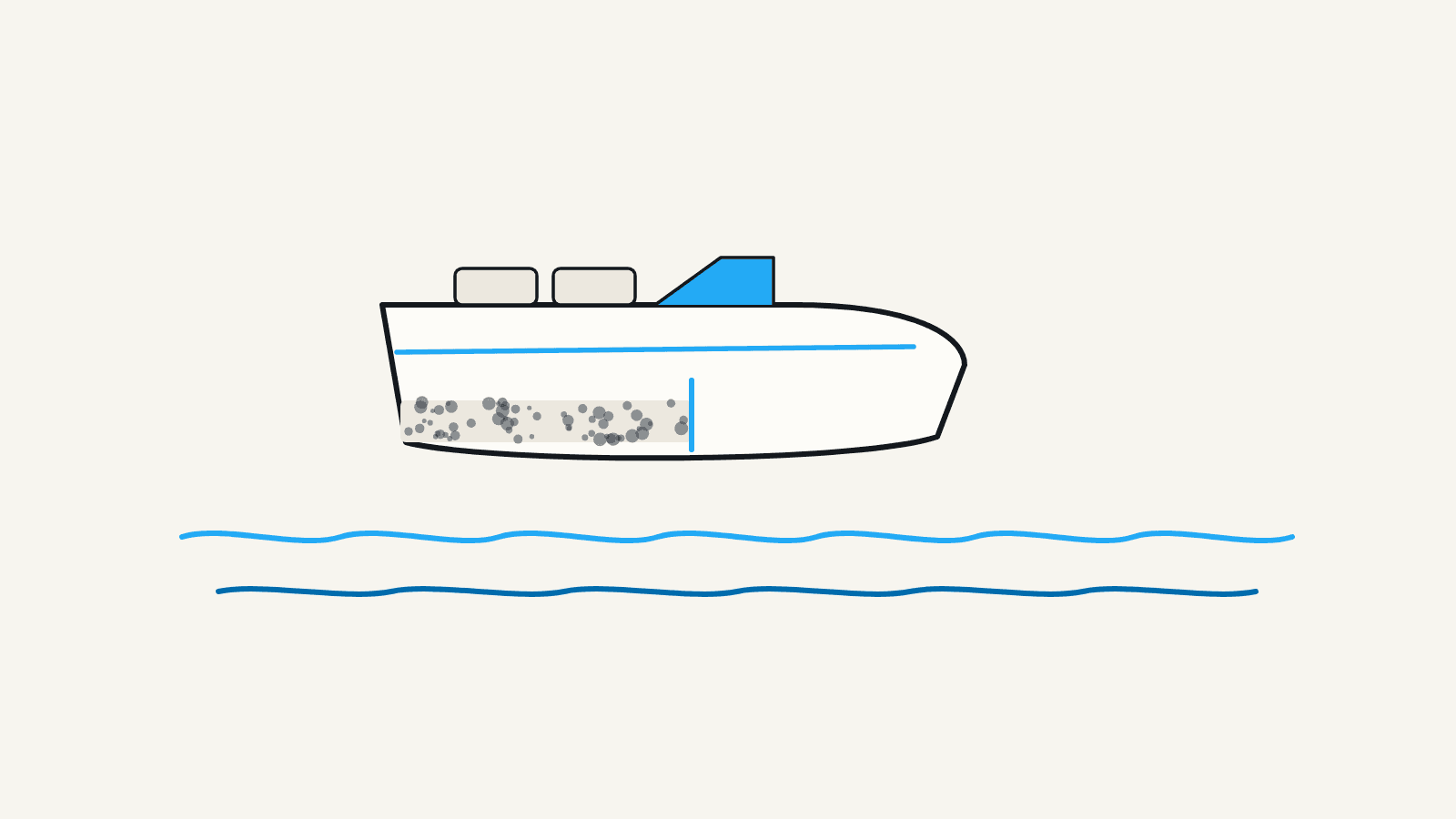
The band of discoloration along a hull at the waterline is usually three separate things layered on top of each other: mineral scale from hard water, tannin and biofilm staining from the lake itself, and iron staining from runoff and rusting hardware.
They look similar and they respond to completely different chemistry. Mineral and iron staining come off with a mild acid. Tannins and biofilm come off with cleaning and agitation. And the reason any of it grips at all is almost always that the gelcoat at the waterline has oxidized, which makes it porous enough to absorb what the water leaves behind.
That last part is why waterline staining keeps coming back on some boats and never appears on others sitting in the same slip.
Telling the three apart
| What it looks like | What it is | Where it comes from | What removes it |
|---|---|---|---|
| Chalky white or gray crust, gritty | Mineral scale | Hard water drying on the hull, tap and lake alike | Mild acid hull cleaner, dwell, rinse |
| Even tea or coffee brown band | Tannin staining | Organic matter in the lake water | Marine hull cleaner and agitation, then protection |
| Orange or rust colored runs and dots | Iron staining | Runoff, trailer hardware, fasteners weeping | Oxalic-based cleaner. Fix the source too |
| Greasy dark line right at the surface level | Scum line, oils and biofilm | Surface film in the slip, sits exactly at the water level | Degreasing wash, worked while wet |
| Dull, absorbent band that stains again fast | Oxidized gelcoat underneath | UV plus constant wet and dry cycling | Polish or compound, then seal the boot stripe |
Diagnosing a waterline band before you pick a product
Why the waterline oxidizes before the rest of the hull
It takes a load nothing else on the boat takes. It is wet, then dry, then wet again, dozens of times in a season, and every dry cycle leaves whatever the water carried behind on the surface. It is also the strip that gets scuffed by the trailer bunks, by docking, and by anything floating.
Meanwhile it is still getting full sun. So the waterline is simultaneously the most chemically loaded and the most abraded part of a hull that is also being degraded by UV, and it degrades first as a result.
Once that band is oxidized it is porous, and a porous surface absorbs staining rather than holding it on the outside. That is the difference between a hull you can wipe clean and one where the same brown band is back four weeks later. The stain is not more aggressive on the second boat. The surface is more absorbent.
If the band comes back every month, cleaning is not the fix
A waterline that reabsorbs staining needs the oxidized layer removed and the boot stripe sealed. That is Gelcoat Restoration work, $28/ft plus a $350 base, and it usually ends the cycle rather than resetting it.
Acid hull cleaners: useful, and easy to get wrong
Mineral scale and iron staining are chemical problems, and mild acids dissolve them faster and more gently than any amount of scrubbing. Used properly, an acid hull cleaner is the correct tool and it works in minutes.
Used carelessly it causes damage that costs far more than the staining did. Four rules matter.
- 1Never use an acid hull cleaner on aluminum. Pontoon tubes, outdrive housings, trim tabs, and any bare alloy will etch, pit, and go permanently gray. Aluminum has its own brightener chemistry for a reason.
- 2Never let it dry on the surface. Work small sections in shade, keep the hull wet, and rinse before it flashes. A cleaner that dries on gelcoat leaves its own stain in place of the one you removed.
- 3Protect what is below and around it. Runoff onto a trailer, a lawn, or a dock is not neutral, and around water it needs containment. Wash water reaching a storm drain reaches the waterway untreated.
- 4Wear gloves and eye protection, and keep it off skin, canvas, and painted trailer frames. This is the one part of boat detailing where the chemistry is genuinely capable of hurting you.
The North Texas twist: your rinse water is part of the problem
Boaters here often do everything right on the lake and then create a second stain in the driveway. North Texas Municipal Water District treats its supply to a moderately hard standard, with calcium bicarbonate, magnesium carbonate, iron, and lime coming naturally from Lavon Lake. Those minerals are harmless to drink and murder on a hull.
Rinse a hot boat with that water in an August driveway and it evaporates in under a minute, leaving every dissolved mineral behind as a fresh scale deposit exactly where the water sat longest. Which is the waterline, because that is where the film runs down to.
The fix is simple and it costs nothing: rinse in the shade or early, and dry the hull rather than letting it air dry. It is also the reason we bring filtered water rather than using whatever is at the ramp.
Slipped boats and trailered boats stain differently
A boat that lives in a slip develops a hard, defined line right at the surface level, because there is a genuine boundary where the water sits and the oils and biofilm on the surface concentrate. It is greasier, more biological, and more even. It also has growth pressure below it, which is a different job entirely.
A trailered boat gets a softer, wider band, because the waterline moves every time the boat is launched and recovered, and much of the staining is spray and splash that dried in place. It is more mineral and less biological, and it responds well to a wash and a mild acid clean.
There is a practical rule buried in that. If your boat is trailered, the waterline is cleanable almost every time, and letting it go for two seasons is what turns an easy job into a correction. If your boat is slipped, the waterline should be part of a regular schedule rather than an annual rescue, and everything below it belongs to a haul-out rather than a detail.
Keeping the band from coming back
- Rinse the hull with fresh water after every outing and dry the waterline rather than letting it evaporate. Almost all mineral staining is created in the ten minutes after the boat comes out.
- Keep wax or a sealant on the boot stripe specifically. It is the part of the hull most people skip when waxing and the part that most needs a barrier.
- Drain the boat properly. Texas law requires removing all water from the boat, motor, bilge, and livewells before leaving or approaching a public fresh water body, and a boat that actually gets drained and dried does not develop the standing water lines and interior smells that show up later.
- Fix the source of any rust staining. A weeping fastener or a corroding trailer bracket will re-stain a hull you just cleaned, every season, until it is dealt with.
- Correct the waterline once rather than cleaning it forever. If the band reabsorbs staining within weeks, the gelcoat there is oxidized, and no cleaning schedule will out-run a porous surface.
This is an educational guide written to help DFW drivers budget and decide with confidence. It is not a binding quote. Your price is confirmed up front before any work begins, with no deposit.