The short answer
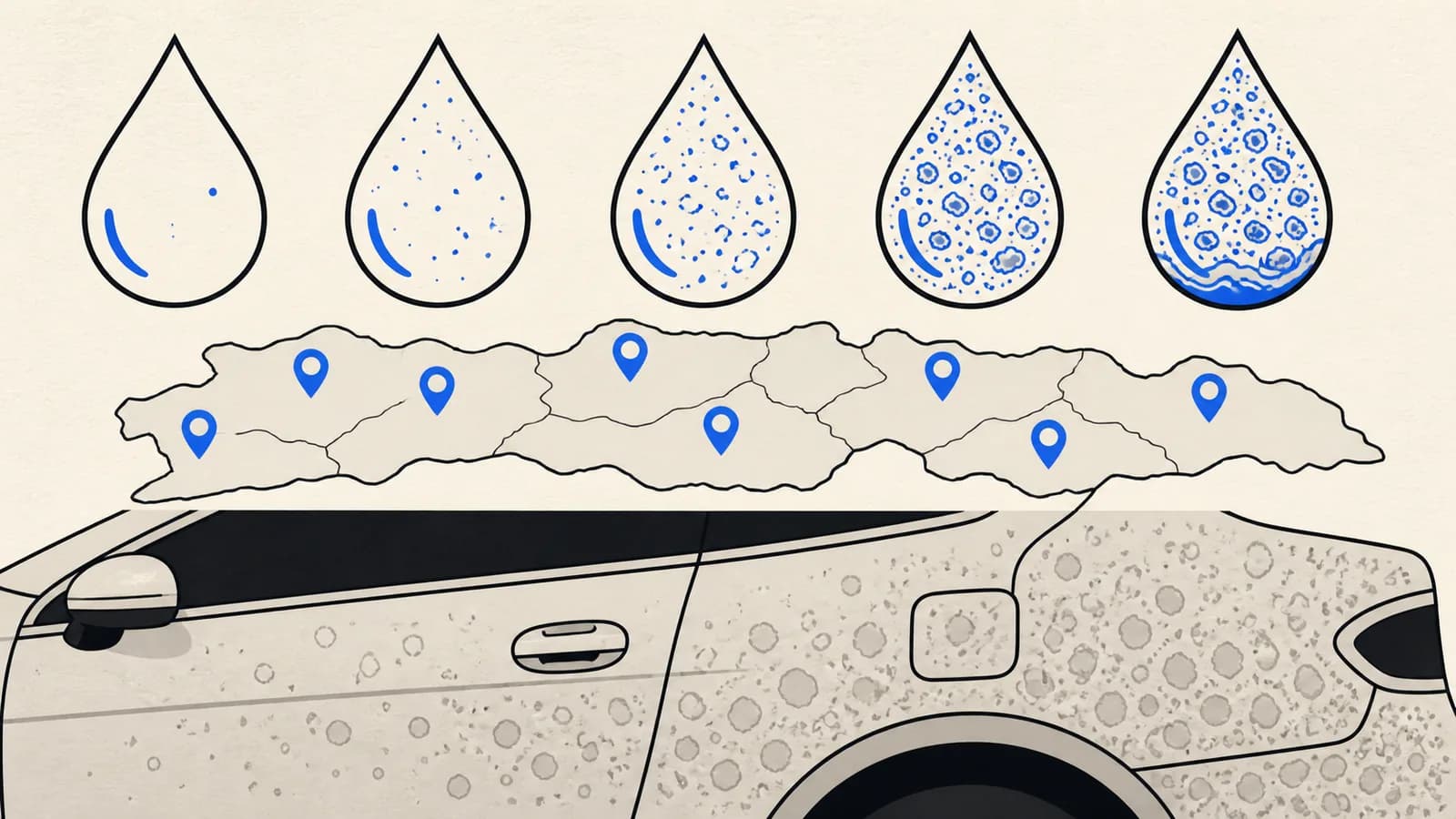
Hard water carries dissolved calcium and magnesium. When a droplet evaporates on your paint, the water leaves and the minerals stay behind as a ring. North Texas water generally tests in the hard range, which is why cars here spot so readily.
You cannot change your tap water, but you can change three things: wash in the shade, dry every panel rather than letting it air dry, and keep protection on the paint so deposits sit on a sacrificial layer.
What hardness actually means
Water hardness is measured in milligrams per liter of dissolved calcium carbonate, or in grains per gallon. The USGS classifies water above about 120 mg/L as hard and above 180 mg/L as very hard. Most North Texas municipal supplies sit in that upper band.
Your own number is published: every water utility issues an annual water quality report, and hardness is listed in it. It is worth looking up once, because it explains a lot about both your car and your dishwasher.
How to wash around hard water
| Approach | How well it works | Notes |
|---|---|---|
| Wash in shade, dry immediately | Very effective | Free, and the single biggest factor |
| Drying aid or spray sealant while drying | Effective | Helps water sheet off rather than bead and sit |
| Deionized or filtered final rinse | Very effective | What professional mobile setups carry |
| Keeping a sealant on the paint | Effective | Deposits sit on protection, not clear coat |
| Rinsing and letting it air dry | Counterproductive | This is how spots form in the first place |
What actually reduces spotting
We bring our own water
Our van carries filtered water and every panel is force-dried, which is why cars we wash do not spot the way a driveway hose wash does. Exterior details from $99.
Finding your own number
Water hardness varies by supplier, by source, and sometimes by season, so a regional average is less useful than the figure for your own tap.
- 1Find your water utility, which is usually your city or a regional water district.
- 2Look for the annual water quality report, often published as a consumer confidence report.
- 3Find hardness, listed in milligrams per litre as calcium carbonate or in grains per gallon.
- 4Convert if needed: one grain per gallon is roughly 17 milligrams per litre.
- 5Compare against the standard bands, where above roughly 120 is hard and above 180 is very hard.
This is an educational guide written to help DFW drivers budget and decide with confidence. It is not a binding quote. Your price is confirmed up front before any work begins, with no deposit.