The short answer
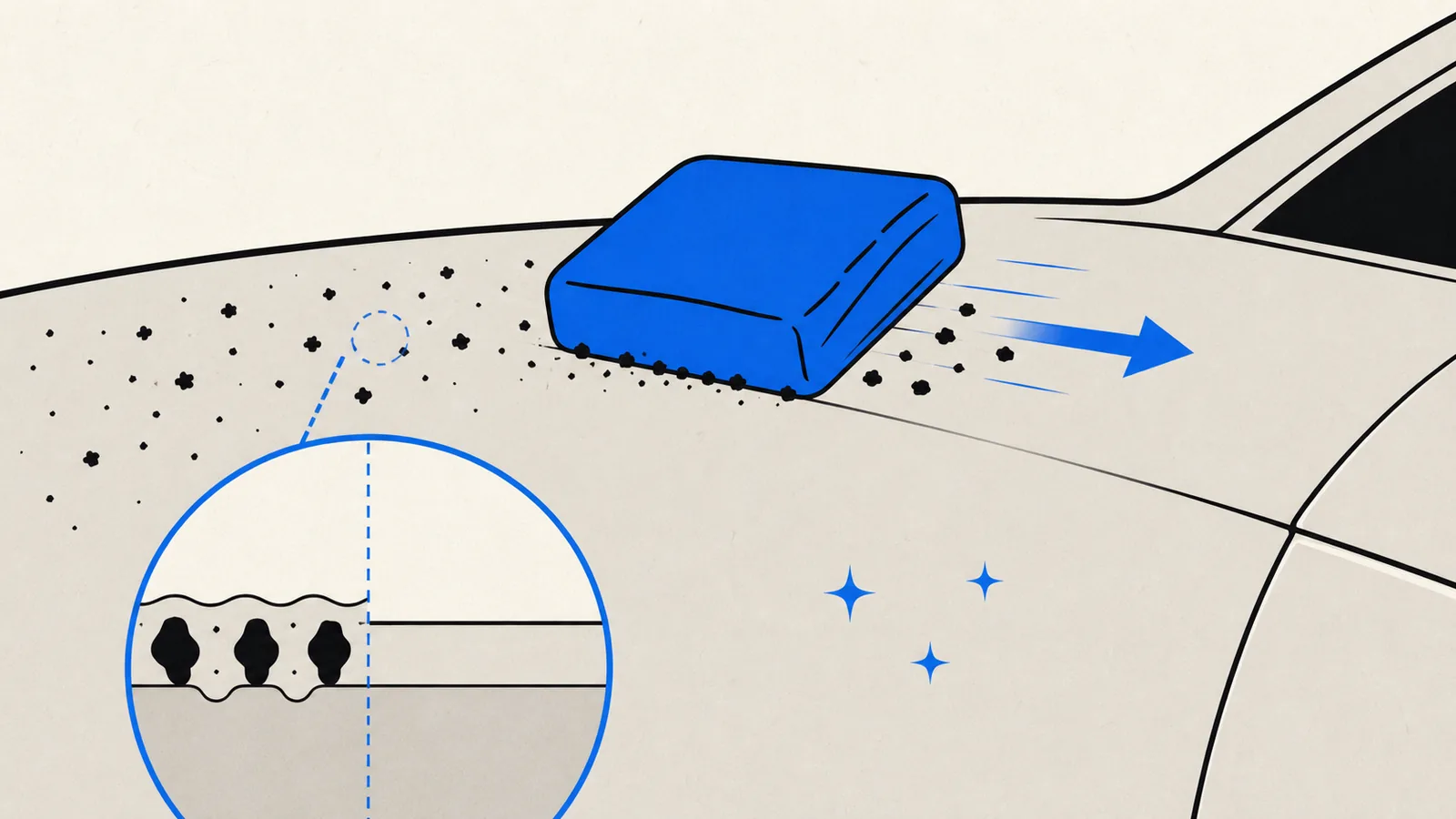
A clay bar is a soft, tacky compound that is glided over lubricated paint. It shears off contamination that has bonded above the surface: industrial fallout, rail dust, overspray, tree sap residue, and mineral deposits. Washing cannot remove these because they are stuck rather than sitting loose.
The result is paint that feels like glass, looks noticeably brighter, and lets any protection you apply afterward actually bond to the clear coat.
The bag test
Wash and dry the car, then put your hand inside a thin plastic bag and run it lightly over the hood and roof. The bag amplifies texture, and on a contaminated car you will feel a distinct roughness that your bare hand misses.
If it feels rough, the car needs decontamination. If it feels like glass, save your money and skip it.
How to use one safely
- 1Wash the car first. Claying a dirty car drags loose grit and causes marring.
- 2Use plenty of dedicated clay lubricant or a soapy solution. Never use clay dry.
- 3Work in small sections with light straight passes, never circles.
- 4Knead the clay often to expose a clean face, and throw it away immediately if you drop it.
- 5Wipe the section with a clean microfiber and feel it again to confirm.
- 6Protect the paint afterward, because claying leaves it completely bare.
Clay plus iron removal is the real reset
An iron remover dissolves what is embedded chemically, then clay shears off what remains mechanically. Both are included in our exterior detail, from $99, and clay alone is available as an add-on at $50.
What clay does not do
It does not remove scratches, swirl marks, or etching, because those are below the surface rather than on it. It does not add gloss on its own, though removing contamination usually makes paint look brighter immediately.
It also causes light marring on soft paint, which is why professional work follows clay with polish or, at minimum, a protective sealant. On a daily driver the trade is worth it; on a show car it is part of a longer process.
Clay bar, clay mitt, or clay towel
| Format | Speed | Marring risk | Best for |
|---|---|---|---|
| Traditional clay bar | Slowest | Lowest with good lubrication | Delicate or dark paint |
| Clay mitt | Fast | Moderate | Large vehicles, heavy contamination |
| Clay towel | Fastest | Highest | Light contamination on hard paint |
| Synthetic clay block | Fast | Moderate | Wheels and glass |
The three formats compared
After claying, which is not optional
Clayed paint is completely bare. Whatever wax or sealant was there is gone, along with the contamination, which means the paint is at its most exposed at exactly the moment it looks its best.
Protect it the same day. On a car that will not be sealed immediately for some reason, at minimum apply a spray sealant, because leaving decontaminated paint bare through a Texas week is worse than not claying it at all.
This is an educational guide written to help DFW drivers budget and decide with confidence. It is not a binding quote. Your price is confirmed up front before any work begins, with no deposit.